By Neda Veleva · · 8 min read
David Sacks at the G20 Innovation Ministerial: AI as a new industrial revolution
The co-chair of the President’s Council of Advisors on Science and Technology cited $800 billion in investment in 2026 and forecast $1.4 trillion in 2027, while defending the use of existing laws and the construction of new energy capacity for data centers.
← Back to overview
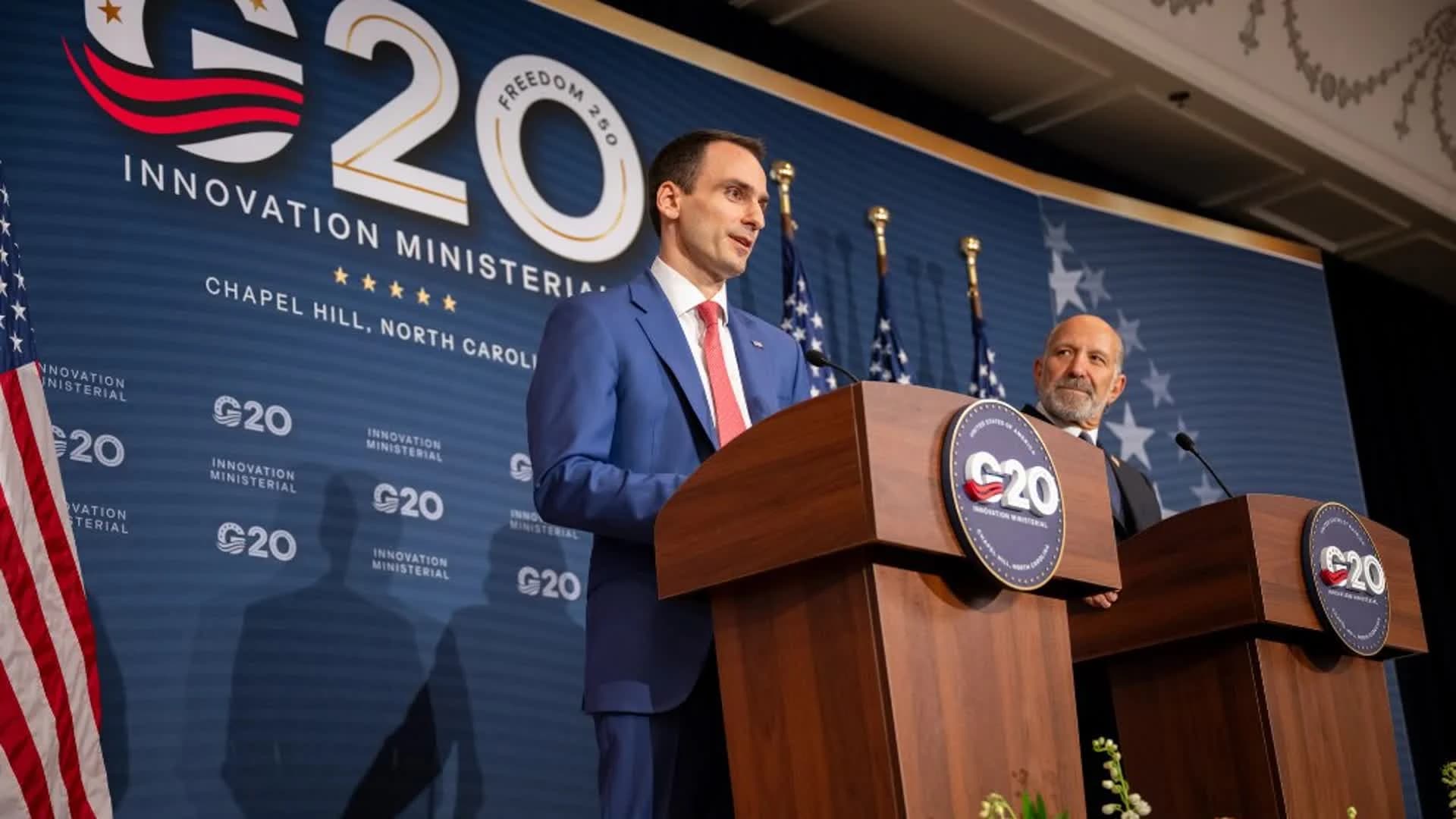
On September 1, 2026, David Sacks joined the public program of the G20 Innovation Ministerial by video. The conversation was led by Michael Kratsios, Director of the White House Office of Science and Technology Policy.
The official closing announcement identifies Sacks as co-chair of the President’s Council of Advisors on Science and Technology. His appearance followed the conversation with Elon Musk and focused on three practical dimensions of AI development: the scale of investment, the regulatory environment, and the infrastructure behind data centers.
His central argument was that AI is no longer just a software industry. Its development requires construction, electricity, manufacturing capacity, chips, and a skilled workforce. This is why Sacks described it as a “new industrial revolution.”
From $800 billion to $1.4 trillion
Sacks stated that approximately $800 billion was being invested in the United States in 2026 in capital expenditure related to AI infrastructure and computing capacity. According to the forecast he cited, the amount could reach $1.4 trillion in 2027.
He emphasized that the estimates are changing quickly and being revised upward as plans for new data centers expand.
To illustrate the scale, Sacks compared the current construction of AI infrastructure to the development of the railroad network in the nineteenth century. In his view, the investment wave already exceeds the rollout of the fiber-optic infrastructure that enabled the widespread adoption of the internet.
This comparison places AI in a different economic category. In Sacks’s reasoning, it is not merely a new set of digital services but the construction of a physical system encompassing data centers, electricity generation capacity, network infrastructure, and specialized hardware manufacturing.
The sums he cited are also reported in The Daily Tar Heel’s report on the first day of the G20 Innovation Ministerial.
An opportunity for new industrial production
Sacks linked AI investment to an opportunity to expand manufacturing in the United States. In his view, building the new infrastructure could accelerate the modernization of the electricity grid and increase demand for equipment, components, and skilled technical labor.
Data centers do not exist in isolation from the rest of the economy. They require building materials, transformers, generators, cooling systems, network equipment, and a continuous supply of electricity. Their expansion creates demand in sectors far beyond software development.
This connection is precisely what underlies the description “new industrial revolution.” For Sacks, AI represents both a technological and a manufacturing transformation, in which computing capacity becomes strategic infrastructure.
Existing laws as the basis for regulation
The second major theme in Sacks’s remarks was regulation. His position began with the assertion that AI is not developing in a legal vacuum.
He identified a number of areas in which laws and regulatory mechanisms already apply:
- fraud;
- discrimination;
- privacy violations;
- defective products;
- copyright infringement;
- the creation and distribution of intimate images without consent;
- anticompetitive behavior.
According to Sacks, these rules should also apply when an offense is committed with the help of AI. His proposed model takes existing laws and institutions as its starting point, supplementing them where necessary with requirements for transparency, disclosure, and independent audits.
He also included antitrust law among the available tools. If the AI market becomes concentrated in the hands of one or two dominant players, Sacks argued, existing competition protection mechanisms could be applied.
This position is consistent with the general direction of the Carolina Principles for Emerging Technologies, under which existing sector-specific rules should be used where they already cover the particular risk.
Why Sacks opposes prior approval of AI models
Sacks opposed the creation of a centralized institution that would approve every new AI model before its release to the market.
He compared such a system to the approval processes for new medicines and aircraft. In those sectors, approval can take years, while AI companies release new models and significant updates every few months.
In his view, applying the same model to AI would create a permanent backlog of products awaiting administrative approval. Sacks described this scenario as a “DMV for AI,” a reference to American departments of motor vehicles, known for their slow administrative procedures.
As an alternative, he defended the principle of permissionless innovation. The idea is that a new product can be developed and brought to market while the law continues to penalize specific violations and harms.
Sacks sees this philosophy as one of the main reasons small teams and young companies can create products that later become global technology platforms.
The differences between this approach and the European regulatory framework are examined in detail in the article on the US and European Union approaches to AI regulation.
Data centers and the price of electricity
The final part of the conversation addressed data centers and concerns that their expansion could increase household electricity bills.
Sacks distinguished between two possible models.
In the first, AI companies connect their new data centers directly to the existing grid and begin competing with households and other businesses for the available electricity. He acknowledged that prices could rise under such a scenario.
In the second model, companies invest in new generating capacity that covers the data centers’ consumption. Surplus electricity can be fed back into the public grid.
The key condition in Sacks’s argument is the creation of additional energy capacity. In his view, data centers can contribute to grid modernization and lower costs only when investment includes new electricity generation, rather than merely new consumption.
He also linked such projects to construction jobs, demand for skilled specialists, and additional revenue for local authorities.
Decisions on individual projects remain local
Sacks also addressed opposition to data center construction in some American communities.
In his words, federal policy should not force local authorities to accept projects they do not want. Decisions on individual data centers should remain at the state and local levels.
His position thus combines accelerated construction of AI infrastructure with the need for companies to demonstrate tangible benefits for the areas where they want to invest. The benefits he cited included new energy capacity, employment, grid modernization, and local tax revenue.
Following his appearance at the G20 Innovation Ministerial, Sacks also summarized his position on data centers in a post on X.
From a software boom to an infrastructure economy
David Sacks’s remarks shifted the conversation from the capabilities of individual AI models to the system required for their development.
The $800 billion in investment in 2026 and the projected $1.4 trillion in 2027 were presented as a measure of the scale of construction. Existing laws, transparency, and audits outlined his preferred regulatory approach. New electricity generation was presented as a condition for data centers to grow without passing costs on to local consumers.
In this picture, AI evolves from a software technology into an industrial system. Its development depends simultaneously on capital, energy, manufacturing supply chains, laws, and the support of the communities where the infrastructure is built.
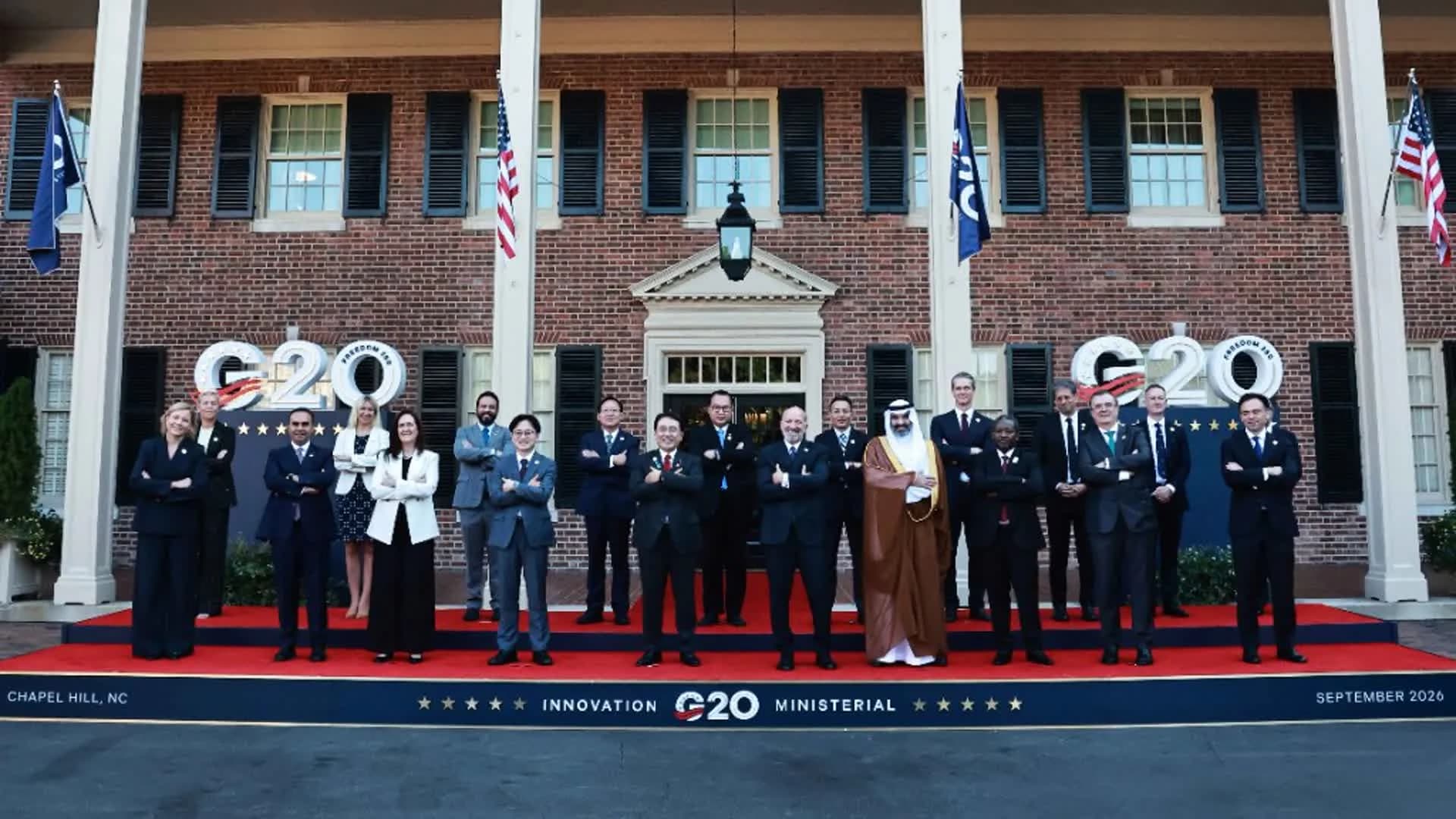
The official documents agreed by the participating countries are examined separately in “What was adopted at the G20 Innovation Ministerial”.
Sources
- whitehouse.govThe White House: official closing announcement for the G20 Innovation Ministerial (opens in a new tab)
- dailytarheel.comThe Daily Tar Heel: coverage of the first day of the G20 Innovation Ministerial (opens in a new tab)
- reuters.comReuters: coverage of the American position on AI regulation (opens in a new tab)
- singjupost.comFull transcript of the public conversation with David Sacks (opens in a new tab)
- youtube.comVideo of the conversations with Elon Musk, David Sacks, and Bob Mumgaard (opens in a new tab)
- x.comDavid Sacks’s post on data centers (opens in a new tab)