By Neda Veleva · · 5 min read
Demis Hassabis at the G20 Innovation Ministerial: from AlphaFold to a new pace of science
The co-founder and chair of Google DeepMind presented artificial intelligence as a tool for accelerating scientific discovery and called for systematic evaluation of the most powerful AI models.
← Back to overview
In conversations about artificial intelligence, the future often appears as a promise. Demis Hassabis joined the G20 Innovation Ministerial with an example of a technology that has already changed how scientists work: AlphaFold.
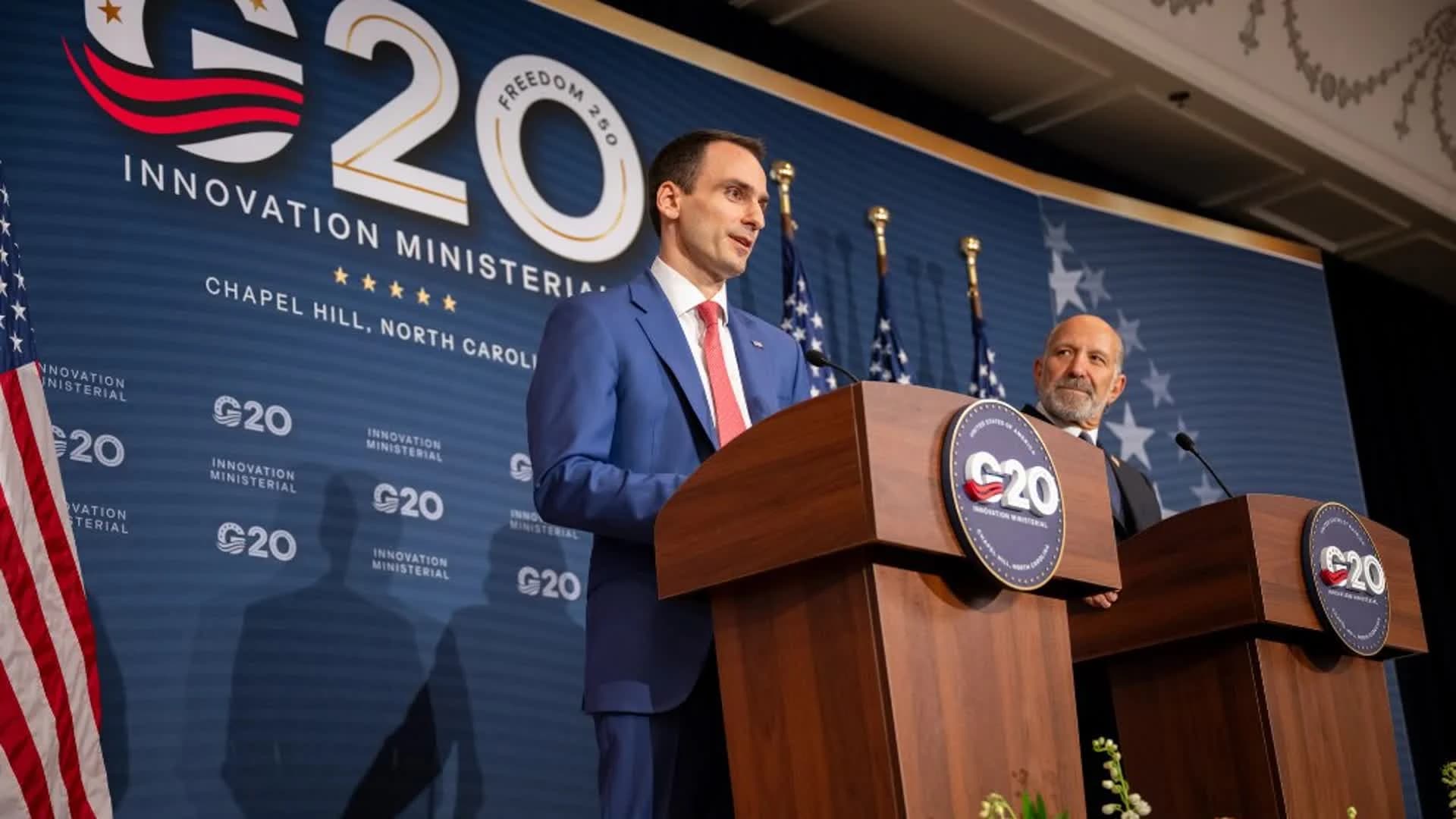
Hassabis participated by video on the first day of the G20 Innovation Ministerial. His conversation was led by Michael Kratsios, Director of the White House Office of Science and Technology Policy. Two themes defined his remarks: the potential for artificial intelligence to accelerate scientific research, and the need to subject the most powerful systems to reliable testing.
AlphaFold as evidence of AI’s scientific potential
AlphaFold is a Google DeepMind system that predicts the three-dimensional structure of proteins from their amino acid sequences. This is a crucial scientific problem, since a protein’s structure is directly linked to how it functions and interacts with other molecules.
For developing AlphaFold2, Demis Hassabis and John Jumper received half of the 2024 Nobel Prize in Chemistry. The system has already been used to predict more than 200 million protein structures, made available to the research community through the AlphaFold database.
This result matters for more than its scale. AlphaFold demonstrates how artificial intelligence can help address a scientific problem that requires significant time and resources to solve using traditional experimental methods.
It was precisely this kind of application that was central to Hassabis’s remarks at the G20 Innovation Ministerial.
From years to months
Hassabis turned to drug development. During the conversation, he expressed hope that AI tools such as AlphaFold could shorten certain stages of the process from years to months and, further into the future, even to weeks.
He also linked greater speed to the possibility of researchers working on hundreds of diseases, rather than concentrating resources on a limited number of areas.
Artificial intelligence can analyze large volumes of biological data, model interactions between molecules, and help select promising candidates for further investigation. This can bring scientists more quickly to hypotheses that can be tested in the laboratory.
Laboratory experiments, clinical trials, and regulatory approval remain separate, mandatory stages. The potential change lies in how quickly researchers can identify and select the most promising directions.
More scope for scientific exploration
Traditional scientific research often requires choosing among numerous possible hypotheses. Time, computing capacity, available data, and the cost of laboratory work limit the number of ideas that can be tested.
AI systems can expand this process. Rather than replacing the scientific method, they can help generate, compare, and prioritize more testable hypotheses.
This is the substantive shift in the scientific vision Hassabis presented. The value of artificial intelligence is not measured only by its ability to generate text, images, or software. It is also evident in its potential to accelerate the journey from scientific question to experiment.
Such an approach is already being applied in biology and chemistry, but its reach could extend into materials science, energy, mathematics, and other fields in which researchers work with an enormous number of possible solutions.
The most powerful systems must be evaluated
At the G20 Innovation Ministerial, Hassabis also raised the issue of safety. According to Reuters, he urged representatives to build capacity for testing AI systems.
His focus was on evaluating the most powerful models. Such tests can measure the capabilities a system acquires, how it behaves under different conditions, and whether it creates risks that need to be managed before wider deployment.
This approach moves the safety discussion from general concerns to concrete assessment. Evaluating a system requires testing methods, access to models, suitable data, and specialists able to interpret the results.
Work in this direction already exists. In May 2026, Google, Microsoft, and xAI agreed to give the US Center for AI Standards and Innovation early access to new models for assessments related to capabilities and national security risks.
Scientific progress and safety as a shared task
In Hassabis’s remarks, scientific potential and risk evaluation were parts of the same picture. The more capable AI systems become, the greater their potential benefits for science. Yet those same growing capabilities make reliable measurement of their behavior increasingly important.
This position aligns with two of the G20 Innovation Ministerial’s main themes: investment in fundamental research and the trustworthy deployment of emerging technologies.
Demis Hassabis’s contribution to the discussion was concrete. AlphaFold shows what can be achieved when artificial intelligence is directed at a clearly defined scientific problem. The next task is to expand these capabilities with the methods, discipline, and checks that science demands.
Sources
- whitehouse.govThe White House: closing announcement for the G20 Innovation Ministerial (opens in a new tab)
- dailytarheel.comThe Daily Tar Heel: report on the first day (opens in a new tab)
- wral.comWRAL: remarks on scientific research and drug development (opens in a new tab)
- reuters.comReuters: positions on AI regulation and testing (opens in a new tab)
- nobelprize.orgThe Nobel Prize: the award for AlphaFold and protein structure prediction (opens in a new tab)
- deepmind.googleGoogle DeepMind: AlphaFold (opens in a new tab)
- reuters.comReuters: US institutions’ access to models for evaluation (opens in a new tab)