By Neda Veleva · · 8 min read
Elon Musk at the G20 Innovation Ministerial: AI, a billion robots, and the electricity shortfall
In a conversation with Michael Kratsios, the CEO of Tesla and SpaceX shared his forecasts for digital work, humanoid robotics, and the energy capacity needed for them to scale.
← Back to overview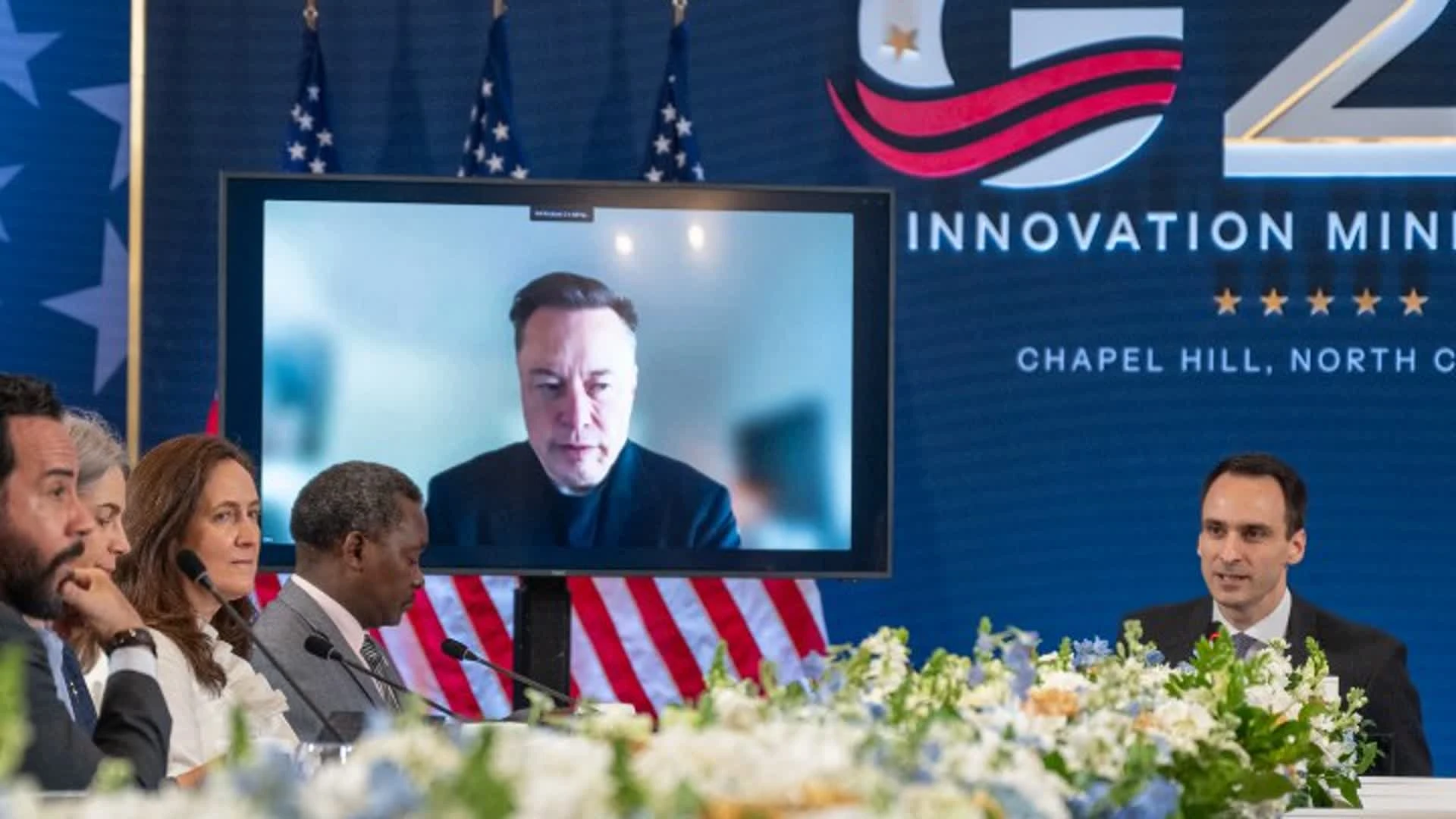
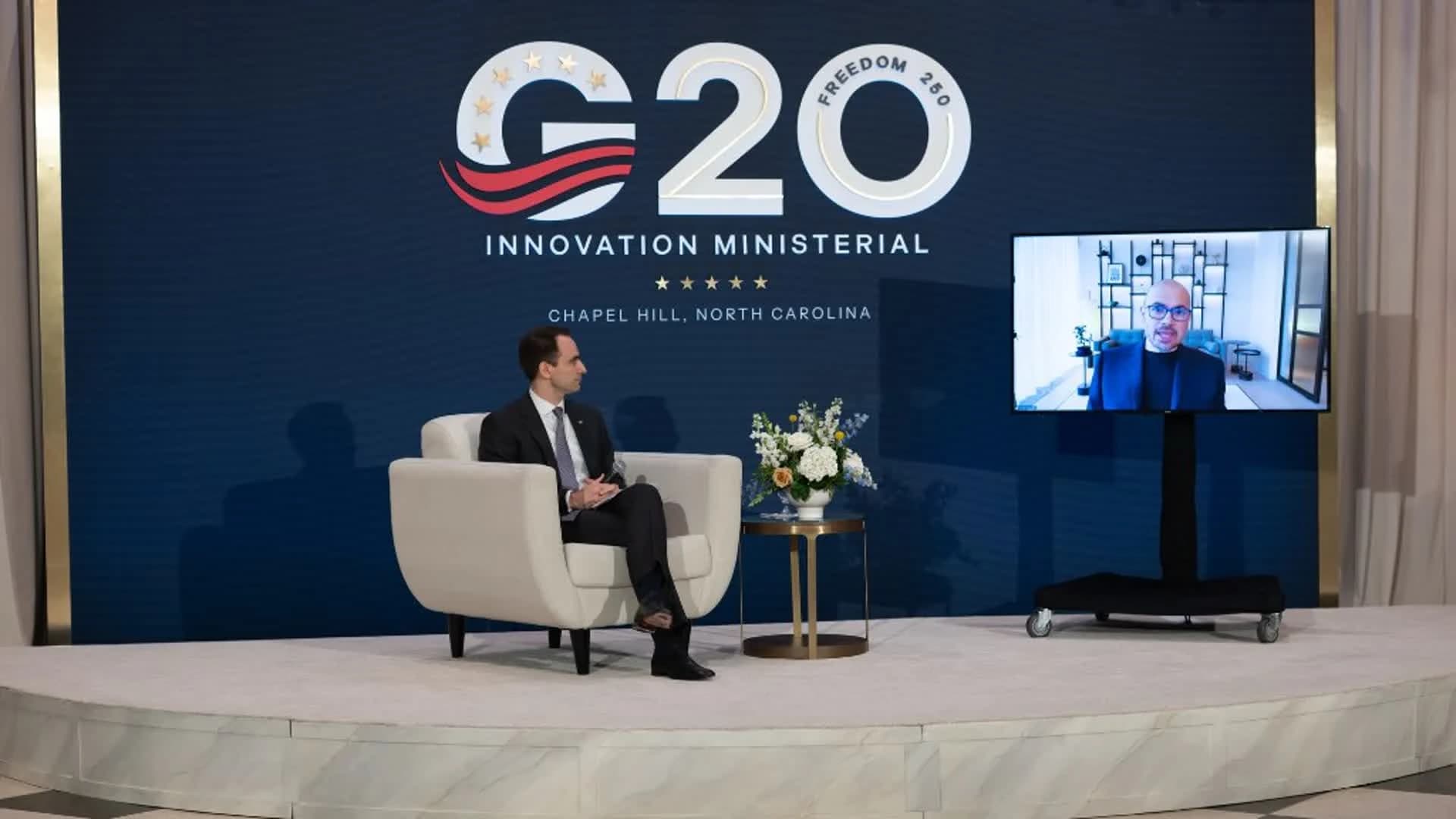
On September 1, 2026, Elon Musk was the first invited speaker in the public program of the G20 Innovation Ministerial. He joined by video for a conversation led by Michael Kratsios, Director of the White House Office of Science and Technology Policy.
Rather than focusing on a single product or company, Musk presented a comprehensive picture of the next stage of technological development. In it, AI expands the capacity for digital work, humanoid robots carry that capacity into the physical world, and electricity generation determines how quickly the new infrastructure can grow.
Musk’s participation and his conversation with Kratsios are confirmed in the official White House closing announcement.
An environment in which new technologies can develop
The conversation began with the question of why some countries succeed in turning scientific and technological breakthroughs into real products, while deployment is slower in others.
In Musk’s view, new technologies should be “allowed by default” unless there is a specific reason to restrict them. He cited the European Union’s regulatory environment as an example of an approach that he believes slows technological development.
The second essential condition Musk identified was access to venture capital and support for new companies. He compared startups to young trees that need more favorable conditions for growth than established corporations. In his view, government policies often direct attention and resources toward large companies, even though young businesses face the greatest difficulties entering the market.
This part of his remarks placed the entrepreneurial environment alongside computing infrastructure and energy. For Musk, technological progress depends not only on what can be created, but also on how quickly a new idea can be financed, manufactured, and deployed.
A forecast of a 20–30% larger global economy
Musk’s broadest economic forecast was that artificial intelligence could increase the size of the global economy by approximately 20–30%. He translated that estimate into additional annual economic output on the order of $20–30 trillion.
Musk presented the figures as his own rough estimate and gave no specific deadline for when he expected the full effect to materialize. His argument concerned the growing ability of AI systems to perform tasks that had previously required human intellectual work.
This forecast primarily concerns digital AI. Musk outlined even greater potential for robotics, since it can extend automation from software processes to manufacturing, logistics, and other activities in the physical economy.
The figures and the context of his remarks are covered in detail by The Daily Tar Heel.
When AI will change digital work
Musk predicted that by the end of 2027, AI systems would be able to perform almost any task that takes place entirely in a digital environment and does not require physical interaction with objects and materials.
He cited software development as the clearest example. In his forecast, AI will reach a level at which a person will no longer be able to compete with it in writing code.
To describe the advantage he expects, Musk drew a comparison with Stockfish. The chess engine surpasses even the best human players at the specific task it was built for. In Musk’s reasoning, a similar moment lies ahead for programming: AI will not merely assist developers but will perform certain tasks at a level beyond the reach of an individual human.
He also gave a horizon of 12–18 months for significant advances in computer vision and other activities carried out entirely through digital information.
A billion humanoid robots in ten years
While software can be distributed almost instantly, physical technologies require factories, materials, and international supply chains. Musk therefore expects robotics to develop more slowly at first, but potentially accelerate sharply as manufacturing capacity grows.
He described the usefulness of a humanoid robot as the result of three interconnected components:
- the quality of the AI software;
- the computing power of the chips inside the machine;
- electromechanical dexterity, particularly the hands’ ability to perform complex movements.
According to Musk, all three components are advancing rapidly. Further acceleration would come when robots begin to participate in manufacturing other robots.
On that basis, he predicted that at least one billion humanoid robots could be produced within ten years. His estimate is that each could achieve productivity at least five times that of a human. Under such a scenario, the robots’ combined productive capacity would exceed that of human labor.
This was the longest-term part of his presentation. It connected the development of AI with industrial production, mechanics, and companies’ ability to build physical systems at scale.
Electricity as an immediate constraint
While the forecast of a billion robots spans the next decade, Musk’s warning about electricity concerned a much nearer horizon.
Citing estimates from analysts in the AI sector, he pointed to a possible electricity shortfall of at least 15 gigawatts in 2027. He attributed this to the gap between the rate at which AI chips are being produced and the rate at which new electricity supply capacity is being added.
Musk estimated annual growth in AI chip production at approximately 40–50%, while available electricity capacity outside China, in his estimation, is growing by around 10–20% a year. If this gap persists, data centers could have more computing hardware than the electricity system can power.
Electricity thus became central to the discussion of AI. Models and chips may advance rapidly, but their actual use depends on data centers, grid connections, and reliable electricity generation.
Musk also presented this as an opportunity for countries able to build new energy capacity and offer it to companies developing AI infrastructure.
From software to an industrial system
Elon Musk’s remarks set out three different time horizons. Within 12–18 months, he expects significant progress in digital tasks. As early as 2027, he predicts an electricity shortfall for AI infrastructure. Within ten years, he expects humanoid robots to reach a scale of at least one billion machines.
The common thread running through these forecasts is productivity. First, AI expands the capacity for digital work. Then robotics brings that capability into the physical economy. Electricity, chips, and manufacturing supply chains determine how quickly this change can happen.
Musk’s conversation at the G20 Innovation Ministerial thus moved beyond the usual debate about the capabilities of AI models. At its center were the material conditions behind them: capital, factories, robots, data centers, and electricity.
Sources
- whitehouse.govThe White House: G20 Innovation Ministerial Concludes with Consensus Statement (opens in a new tab)
- dailytarheel.comThe Daily Tar Heel: coverage of the first day of the G20 Innovation Ministerial (opens in a new tab)
- reuters.comReuters: coverage of the discussion on AI regulation and energy (opens in a new tab)
- singjupost.comFull transcript of the conversation with Elon Musk (opens in a new tab)
- youtube.comVideo of Elon Musk’s appearance (opens in a new tab)